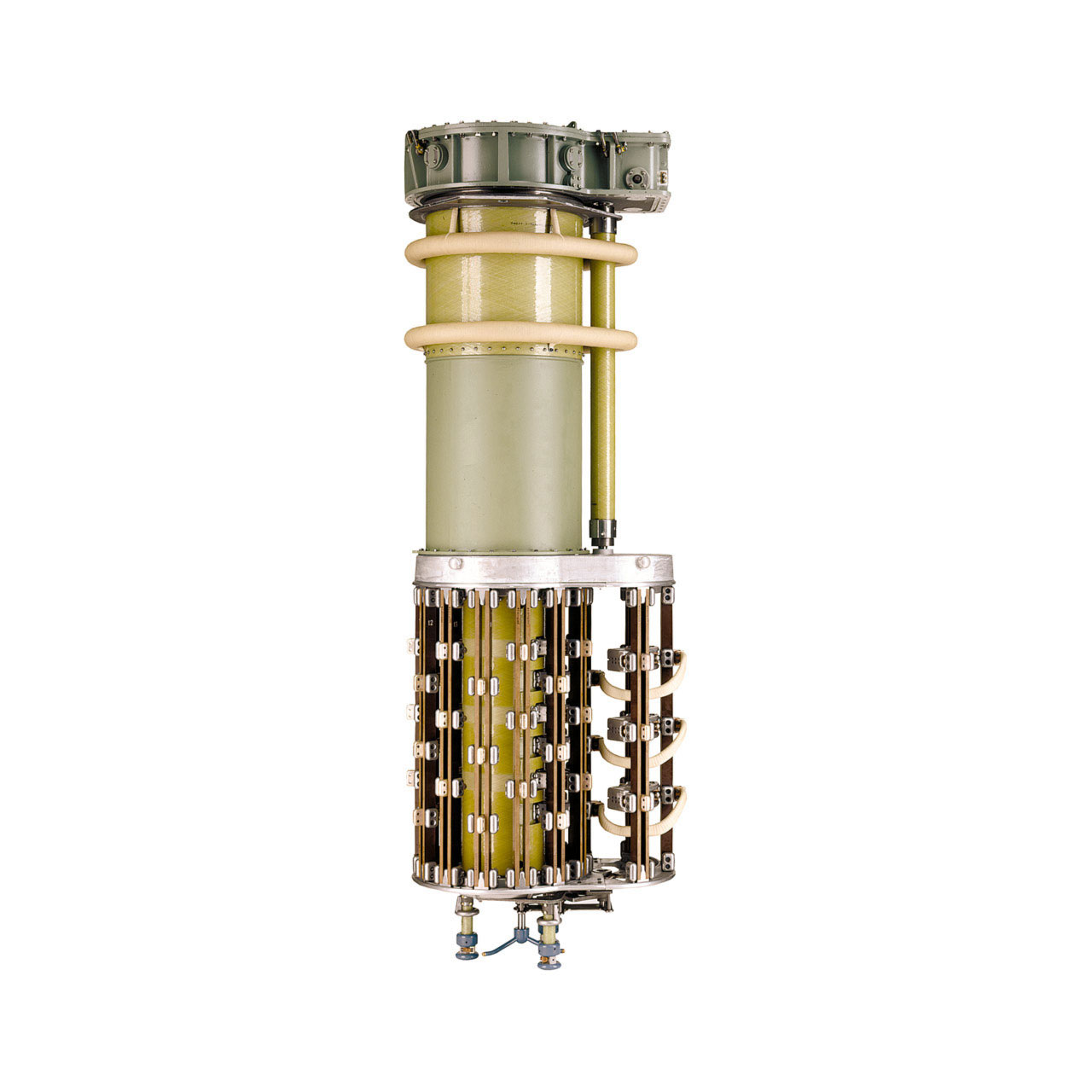
The on‑load tap changer keeps pace with global grid expansion and reaches new performance dimensions—engineered for the highest voltages and exceptional applications.
With advancing network expansion outside Europe at higher system voltages for the transmission lines up to 765 kV, there was a desire for OLTCs with higher load currents and switching capacities. In addition, the increasing performance data of the power plant units, the generator step-up transformers needed OLTCs with higher load currents, which could not be covered by MR’s Type F.
Despite the anticipated low production volumes, MR has taken on this challenge and had developed the Type G, which could handle even the largest three-phase load currents and was, therefore, also good for transmission power transformers with the highest system voltages. The switching principle is a single-resistor mode but the OLTC is in every respect greater than anything that had come before. MR’s Type G has also been approved for use in German nuclear power plants. After introduction of glass fiber reinforced composites with Type M in the 1970ies, the insulation to ground of the diverter switch oil vessel of Type G, which was originally made from oil-impregnated hard paper, became a FRP tube.
Type K was designed for special applications and was available only as single-phase OLTC.