
Power grids must remain stable, even when the load changes. Transformers ensure this by adjusting the voltage so that devices function reliably. To do this, transformers can absorb and output different voltages.
To adjust this voltage during operation, so-called tap changers are used, which control different winding taps.
When switching the taps of a regulating transformer, high current peaks (inrush currents) occur briefly when the contacts change from one winding tap to the next.
Before the invention of the resistor-type tap-changer, transformers had to be switched off before switching and then switched on again afterwards. The result in a time of isolated networks: power outages.
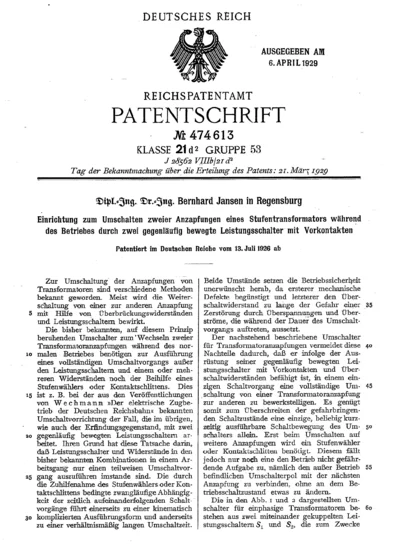
The resistor-type tap-changer developed by Dr. Bernhard Jansen solves this problem with a two-stage switching principle.
The critical moment is the transition phase, during which high currents or sparks could otherwise occur. To prevent these hazards, the contact change takes place in milliseconds and with clearly defined resistance.
A resistor-type tap-changer essentially consists of:
The contacts move in a precisely defined sequence (switching logic) to prevent any short circuits.
This invention made voltage adjustment possible during operation for the first time. This was crucial for:
Without the invention of the resistor-type tap-changer, the meshing and flexible grid control we know today would be inconceivable. Today, MR solutions control around half of the world's energy.