A True Evolution: 100 Years of On‑Load Tap Changers

Like every successful technology, the on‑load tap changer has not evolved in a linear way. Over the decades, new design principles, materials, and application classes emerged—developing in parallel, branching out, and repeatedly recombined. This evolution tells the story of a technical system that has continuously adapted to changing energy, grid, and market requirements—leading up to today’s integrated vacuum era.

  • Evolution
    • Year / Period
      • 1933 – 1977
      • 1978 – 1999
      • 2000 – 2026
    • Power Grids
      • Extra‑High‑Voltage Grids
      • High Voltage Grids
      • Distribution Grid
    • EN: Löschmittel
      • Oil
      • Vacuum
      • Dry
    • Switch
      • Diverter Switch
      • Selector Switch
    • Insulation
      • Pressboard
      • GFRP
  • Reset filter
Back to list
  • 1978 – 1999
  • Extra‑High‑Voltage Grids
  • High Voltage Grids
  • Oil
  • Selector Switch
  • GFRP
1979

Adaptation Through Simplification
Types V and H

The selector switch returns in an optimized form—compact, suitable for series production, and tailored to regional requirements worldwide.

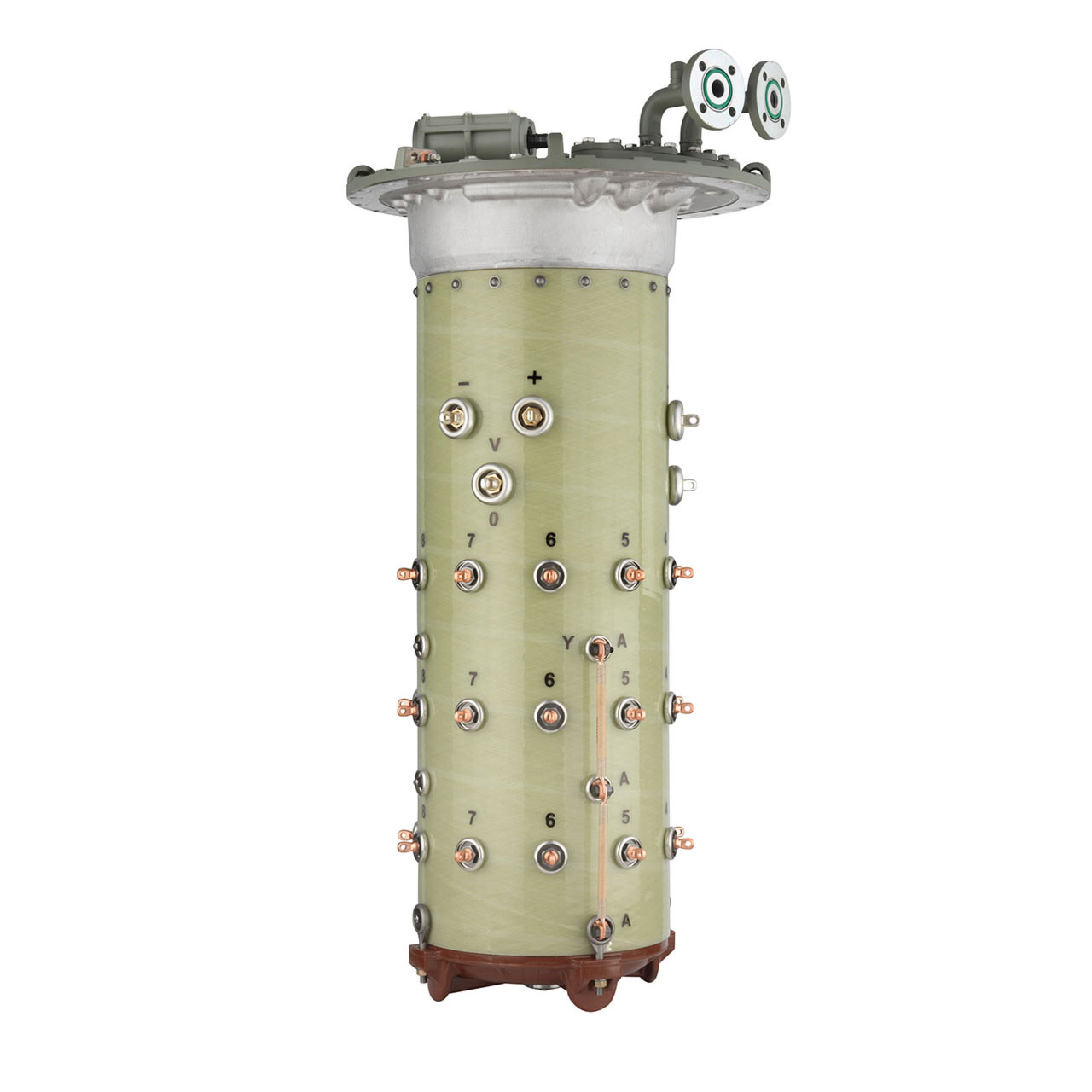
Types C and B were replaced by Type V. MR’s Type V was intended for line-production. Its design can be described as extraordinary at the time of its introduction, as both the oil compartment and the drive shaft were made of glass fiber reinforced composite materials. 

The basic concept was initially introduced for MR’s Type M. As well as MR’s Type M the Type V became a success story. The concept was copied by other manufacturers.

Due to the compact design of Type V the high-voltage insulation was limited for the use in delta connected windings up to an Um of 72.5 kV (76 kV). Especially in Brazil and other countries of South America, there was a need for OLTCs to be used in delta-connected windings up to 145 kV. MR’s solution for those requirements was the development of Type H. The basic design was the same as for Type V but with increased insulation distances.